On Day Zero, when Tara and I spent two hours on the phone “chatting,” I asked her, “What were you doing the last time you thought to yourself This is really great.”
My question was met with silence, leading me, at first, to think that maybe there’s not been anything great for her recently. Quickly, I reframed my question: “Or maybe it would be better to ask, When was the last time you were really happy?”
I was hoping she might cite something from the near recent past, not something from before last June, when Tara’s world was permanently altered without notice or foreshadowing.
Just a year ago, everything in Tara’s comfortable and predictable life had been progressing down a thoughtfully planned, pre-charted path, providing her with a sense of security and no reason to look for landmines that had been buried along the way.
When you live in a war zone, you expect violent disruptions. Planes overhead in Kyiv hold a different sort of significance to those flying over Montana.
No one expects bombs here.
No one expects landmines.
This past September, three months after the leveling of her life, I travelled to visit her.
Pieces of her past remained scattered all around. And while she’d already picked up the big ones over the summer, three months out, detritus remained.
Together, we gathered up some of these pieces. We looked them over together. She disposed of some. Set others aside for later consideration.
I went home.
Just now, I scanned through our texts from last September until her Day Zero “Do you have time to chat?” one.
Here’s what I found:
Three book recommendations, all mine: DEMON COPPERHEAD, NEVER LEAVE THE DOGS BEHIND, and THE BEST MINDS
A movie suggestion, also mine: POOR THINGS
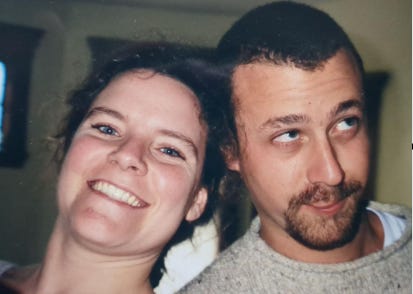
I sent her a photo of herself and Rob from 1995 when Rob and I were first dating:
There were several photos of her dogs, several of mine. (I won’t bore you with those, despite my complete lack of boredom when it comes to dog photos.)
I sent her a meme about Midwesterners and Tupperware.
I requested her recipe for German Pancake, a breakfast I remembered her making for me and my children when she was living in Green Bay, Wisconsin fifteen years ago.
I list these texts to illustrate how shallow our interactions tend to be when we use that mode of communication. It seems we both regard it as a shallow form of communication for us.
When we “chat” on the phone—once a year or not at all some years—we delve deeply into the difficult aspects of being human, centering our attention on parenting, on marriage, on work, on living well in an unwell world. These chats lack fluff, and because they are always meaningful, they are as hard to have as they are rewarding to learn from.
If we’re going to “chat,” we both bring our best selves and our full attention.
My conversations with her have been some of the best of my life.
Knowing Tara as I do, it didn’t come as a surprise to me that Tara’s answer to my second/reframed question was “I was hiking. That’s when I last felt happy: out in nature, hiking with my dog.”
To this, I could completely relate.
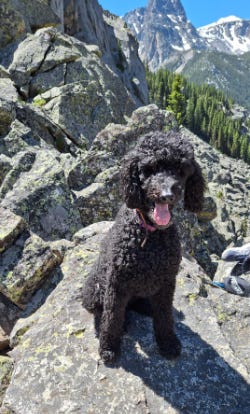
Some people swim, some people run, Tara and I both hike and agree it’s better if the dog’s there.
Her Charlie:
My Kanga:
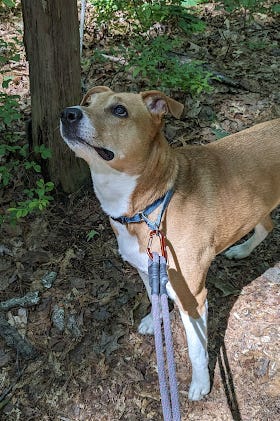
Both dogs are “hiking” in these pics.
Of course, Charlie’s “hike” looks more like Alpine mountaineering, while Kanga’s is obviously such an easy stroll that she can safely take her eyes off the trail to gaze longingly at the tree-safe squirrels mocking her from on high.
On Day Zero, Tara wanted to “chat” because she was at a crossroads.
While the dust had settled from last June’s devastation, Tara was (and had been for a while) considering selling her house (her greatest asset) to move “to town” to live in a condo in order to be close to a job that she was pretty sure she’d hate.
Imagine no meaningful chats (by phone or in person) for months on end (September to June) and then hearing that your oldest friend was about to embark on something she already suspected was going to suck.
I heard her say, in essence, I don’t want this, and I don’t know how to avoid it.
I heard her ask, in essence, What should I do?
“Should” is a loaded word. When someone says you “should” do something, that someone is imposing their worldview on you, oftentimes reinforcing the “should” with “if I were you.”
Years ago, Rob told me that he was trying not to say “should.”
As a mental health counselor, Rob avoids giving “advice,” seeing his professional role as helping his clients to figure out for themselves what’s meaningful and what’s not.
“Should” had/has no place in his vocation, and out of curiosity, Rob decided to bring that restraint on language into his personal life, where, instead of “should,” he uses phrases like “I might suggest” and “You could choose to consider,” as well as my favorite—“You could do nothing”—when speaking to me, our children, and non-clients.
Seeing this in practice, I, too, adopted it for my personal communication. Nowadays, “should” only comes out of my mouth when I’m speaking to my youngest child, who’s legally still a “child” despite being 17 years old. My other three children, all legally adults, now hear me say “I might suggest” and “You might want to consider;” they do not hear me say “you should.”
I strive to never use “should” with my friends and other self-actualized adults.
So, as per my commitment, I wasn’t about to “should” Tara, even if that’s what I thought she was asking for.
Instead, on Day Zero, I said something along the lines of “if hiking makes you happy, you might consider doing that in combination with your skill set.”
My idea was to connect Tara’s love of hiking with her professional skills as a social worker, i.e., hike with women and listen to them talk about their (largely sexual) trauma. Not therapy as much as it would be her offer to carefully listen with her insightful, well-trained ear.
When Tara informed me that “sitting therapy” isn’t as successful as “moving therapy”—when it comes to neuroscience and trauma-work—I felt like this was further evidence of the merits of hiking while doing trauma-work.
I said, “You could revolutionize the way this work is done. If bodies in motion lead to the healing of bodies scarred by trauma, why not do that? You could start a whole new way of approaching this work.”
I went on to say that many, many women would benefit from this kind of help.
Women are of our bodies—and women’s bodies, which were once girls’ bodies, are treated differently from men’s/boys’ bodies.
Autonomy in our culture has a double standard, and women know this.
“It could be super niche: you hike with women in their 50s who have arrived at a place in their lives where they might be ready to broach these traumas. Women of this age are looking critically at their lives. Those who raised children are either done or close to it, and they have the time to work on themselves in a way they hadn’t before.”
On Day Zero, Tara was keen to this.
On Day 1, she was still on board. I arrived late on Day 1.
On Day 2, over morning coffee, she pointed out that “artists” who make a living with their “art” end up hating art. She shared the example of an art therapist. My immediate reaction, which I did not share, was, “forcing a creative to be creative is not at all like doing something you love while doing something that could earn you money.”
When Tara added that she didn’t want to “ruin hiking” (her physical meditation) by combining it with other people’s trauma-work—despite what she had to say about the neuroscience behind healing deep trauma—I saw where her head was.
After coffee, we went “to town” to walk through a condo that she had been thinking about buying—in order to be close to a soon-to-start job that she was pretty sure she wouldn’t like.
Side note: During our Day Zero chat, we talked at length about the costs and demands of keeping her mountain-top house. She was planning on selling it through a realtor who was seriously underpricing Tara’s house. I suggested that Tara tell the realtor that the listing price would need to be much, much higher or Tara would find a different realtor to work with. Then, Tara said, “I could probably sell it on my own.” On Day Zero, we agreed that figuring out how to do sell it on her own would be one of the tasks she and I would work on together during my visit.
As we walked through the condo, she became more and more sure that staying in her house was what she ought to do, which thrilled me because I know her well enough to know that her house is a sanctuary—for her, for her adult children, and for her very large extended family.
As we drove away from “town,” she said, “And my house is the only one that can accommodate all fifty of us.”
(Note: Tara does not have a 25-bedroom home, but she’s got 40 acres of land for RVs and tents.)
Tara’s extended family—she’s the youngest of four—is very important to her—important in a way that is rare in our itinerant cancel culture, important in a way I aspire to with my own family.
As much as I think and believe that Tara could change the trajectory of women’s lives by doing this difficult work with them, while hiking (maybe with Charlie along as well), she’s not ready for that.
Yet.
However, she’s decided to keep the house, where these unfiltered photos were taken:
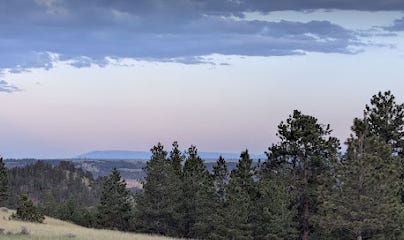

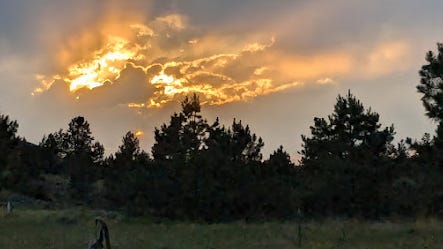
So for now, Tara’s keeping the house and the views, a decision she should (and does) feel good about.

 Jenna Brownson