It was clear on Sunday afternoon that Tara would absolutely be going to work on Monday.
Although she’d expressed misgivings about the work she would be doing, this new job was her chance to get health insurance (after 30 days) and a regular paycheck—two undeniably important and relevant matters that could not be realized were she to take the risk of launching an enterprise of her own.
Irrespective of my endorsement of her skills and the potential market for her self-employment—and her belief in the reasonableness of my enthusiastic endorsement—Tara’s more practical than she is impulsive.
Impulsivity is nearly always seen as a negative, and there’s plenty of conventional wisdom, well expressed in idioms, to discourage it:
Look before you leap.
Don’t count your chickens before they’re hatched.
A bird in the hand is worth two in the bush
Then, there are those carts and horses, eggs and baskets, and well-aligned ducks.
All of these ideas support the value of avoiding unnecessary risks.
On Sunday afternoon, she said, “I can’t not go to work tomorrow,” paused, and added, “Well, I could not go, but I won’t. I’m going.”
Just the day before, on Saturday, I’d made the (impulsive, reasonable, who’s to say?) decision to buy a plane with only a few hours to spare before take-off.
I’d never done anything quite like this before.
I announced to my family that I’d be leaving in two hours on a one-way ticket to Montana. There was no discussion. There wasn’t time.
I was embarking on a quest to convince my friend not to go to a job she presumed she’d hate and to, instead, help her sell her home without the help of the opportunistic realtor who had way underpriced Tara’s house, thereby ensuring a quick sale and $50k in commission. I made the argument that if Tara sold her house on her own, something she thought she could do (with my help), the money she’d not end up forking over to this (unethical?) realtor could cover her living expenses as she began to establish her self-employment.
My ideas sounded good in theory, but by Sunday, the practical application of these ideas was another matter. The practical application felt too risky for her.
However, Tara had made a decision.
She would not be selling her house. She wanted to stay. This meant that any tasks related to figuring out how to sell her house without the assistance/exploitation of a realtor were not longer part of my quest.
And because Tara had decided to start work, any tasks related to setting her up to go into business for herself were also off the table.
So, within 24 hours of my arrival, I was quest-less.
I started looking for a return one-way ticket home.
With Tara was gone all day for on-boarding at her new job, I was able to spend all of today thinking critically about my own impulsivity.
It was silly for me to think that my impulsivity (flying to Montana on a few hours’ notice) would translate into Tara being impulsive (blowing off a job she agreed to take and hanging up a shingle of her own).
It was egotistical for me to believe that my friend could be convinced to do something not in keeping with her pragmatism.
However, it was enlightening for me to travel 2,266 miles to discover that this quest, in many ways, was a noble distraction—but a distraction nevertheless—from the work I know I need to do, primary of which is finishing my novel.
When I initially found this image, I was going to assert that the woman represents me and the horse is Tara.
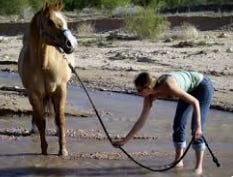
Upon further reflection, it has become clear to me. I’m the horse and the woman is my manuscript—and this little adventure to Montana has made me thirsty to finish it.

 Jenna Brownson